 English
 Spanish
 French
 German
 Italian
 Chinese (Simplified)
 Japanese
 Korean
 Arabic
 Portuguese
 Call Us : 08045800544
 Call Us : 08045800544
 Get a Quote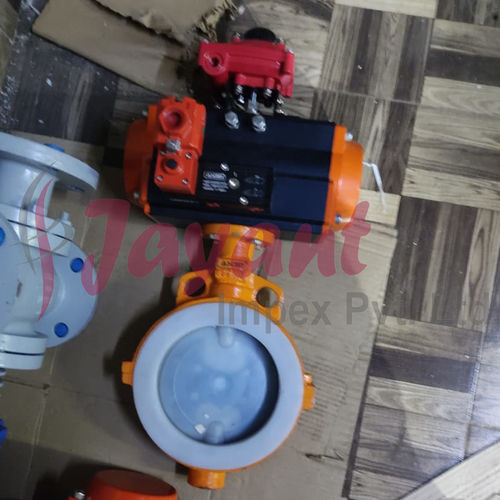
PTFE Butterfly Valve With Pneumatic
5000.00 - 12000.00 INR/Number
Product Details:
- Power Consumption Low Power, Pneumatic Operation
- Working Presssure 10 bar & 16 bar
- Operating Voltage 24V/110V/220V/380V AC/DC (According to Pneumatic Actuator Type)
- End Connection Flanged as per DIN/ANSI/JIS
- Material PTFE (Polytetrafluoroethylene) Body and Disc, Stainless Steel Components
- Valve Structure Butterfly Valve
- Way Type Double Flanged
- Click to view more
X
PTFE Butterfly Valve With Pneumatic Price And Quantity
- 01 Number
- 5000.00 - 12000.00 INR/Number
PTFE Butterfly Valve With Pneumatic Product Specifications
- White/Blue Coated Body
- Varies with size, e.g., 8 kg for 2 valve
- Up to 200°C
- Customizable, standard range available
- Wafer/Lug/Flanged
- PN 10/16 (10 to 16 bar)
- Chemical, Pharmaceutical, Food Processing, Water Treatment
- Double Flanged
- Precision Casting
- PTFE (Polytetrafluoroethylene) Body and Disc, Stainless Steel Components
- 10 bar & 16 bar
- Corrosive Fluids, Gases, Water, Slurries
- Low Power, Pneumatic Operation
- Butterfly Valve
- Flanged as per DIN/ANSI/JIS
- 1 to 24 (25mm to 600mm)
- 24V/110V/220V/380V AC/DC (According to Pneumatic Actuator Type)
- -20°C to 200°C
- Varies as per valve size and media
- Bubble Tight Shutoff
- Spring Return for Fail-safe, Manual Override Option
- 100% Tight Shutoff
- API 609, ISO 5752
- Low, Designed for Easy Cleaning and Replacement
- PTFE with EPDM or Viton Backup
- Epoxy Powder Coating
- -20°C to +70°C
- Streamlined Profile for Low Torque
- 3 to 8 bar (for Pneumatic Actuator)
- Mechanical Visual Indicator
- Double or Single Acting Pneumatic Actuator
- SS304/SS316
- ISO 5211 Mounting Pad
PTFE Butterfly Valve With Pneumatic Trade Information
- Nhava Sheva
- 5 Number Per Day
- 1 Week
- Asia, Central America, North America, South America, Eastern Europe, Western Europe, Middle East, Australia, Africa
- All India
Product Description
A butterfly valve actuator controls the flow of gas or liquid by means of a disk, which turns on a diametrical axis inside a pipe or by two semicircular plates hinged on a common spindle, which permits flow in only one direction.
Butterfly valves are often distinguished by the three main types: zero, double, or triple offset.
- Zero Offset Butterfly Valves.
- Double Offset Butterfly Valves.
- Triple offset butterfly valves.
Reliable Shutoff Performance
Achieve 100% tight shutoff with the PTFE Butterfly Valve, which features a bubble-tight sealing capability and is designed for low torque operation. The combination of PTFE and EPDM or Viton backup ensures excellent resistance to aggressive media, with mechanical visual indicators for secure and visible valve positioning.
Versatile Application and Easy Installation
Suitable for double flanged installation in process lines, the valve is ideal for chemical, pharmaceutical, food, and water treatment sectors. Its ISO 5211 mounting pad and flanged ends compatible with DIN, ANSI, and JIS standards make it easy to integrate into various systems, while its customizable dimensions meet specific process requirements.
Enhanced Safety and Low Maintenance
This valve features a spring return mechanism for fail-safe operation and manual override for added control during emergencies. The epoxy powder-coated body and streamlined disc design reduce torque, minimize wear, and facilitate effortless maintenance, cleaning, and replacement, ensuring long-term reliability.
FAQ's of PTFE Butterfly Valve With Pneumatic:
Q: How does the PTFE Butterfly Valve with Pneumatic Actuator ensure leak-free operation?
A: The valve uses a PTFE sealing material with EPDM or Viton backup, achieving bubble-tight shutoff and 100% leakage prevention, even under challenging media conditions. Compliance with API 609 leakage class ensures reliable performance.Q: What industries commonly use this butterfly valve?
A: Chemical, pharmaceutical, food processing, and water treatment industries utilize this valve due to its resistance to corrosive fluids, gases, water, and slurries, along with its adaptable connection options and robust performance.Q: Where can this valve be installed, and what are the connection options available?
A: This valve is suitable for double flanged installations and can be connected via wafer, lug, or flanged types compatible with DIN, ANSI, or JIS standards, providing flexibility for new setups and retrofits across various processing plants.Q: How is maintenance performed and what are its advantages?
A: Maintenance is straightforward thanks to the valve's design for easy cleaning and replacement. The streamlined disc profile and stainless steel components minimize wear, reducing the frequency and complexity of service.Q: What safety features are included in this valve design?
A: Safety features include a spring return mechanism for fail-safe automatic closure and a manual override option for operational control in the event of actuator failure, ensuring maximum process safety.Q: When should you choose a double or single acting actuator setup?
A: Single acting (spring return) actuators provide fail-safe operation in critical processes where automatic closure is required during system failures, while double acting actuators are preferred when both opening and closing require pneumatic control.Q: What benefits does the streamlined disc design offer in operation?
A: The streamlined disc profile is engineered to result in lower torque output, providing smoother operation and improved energy efficiency while prolonging actuator and valve life.Tell us about your requirement

Price:
Quantity
Select Unit
- 50
- 100
- 200
- 250
- 500
- 1000+
Additional detail
Mobile number
Email

Other Products in 'Solenoid Valves' category



JAYANT IMPEX
GST : 27AAQFJ5764L1ZJ
GST : 27AAQFJ5764L1ZJ

- 6th, 605, Majestic Shopping Center, Jagannath Shankarseth Road, Girgaon,Mumbai - 400004, Maharashtra, India
- Phone : 08045800544

- Mr Shrenik Prakash Mehta (Director)
- Mobile : 08045800544
-
jayantimpex12@gmail.com


-
Share to



 Send Inquiry
 Send SMS
 Call Me Free
JAYANT IMPEX PVT. LTD. All Rights Reserved.(Terms of Use)
Developed and Managed by Infocom Network Private Limited. Terms of use | Returns Policy Member
Developed and Managed by Infocom Network Private Limited. Terms of use | Returns Policy Member
